
Frequently Asked Questions
What if we don’t see whales?
The Salish Sea is home to an astonishing variety of whales, including orcas, humpbacks, gray whales, and minke whales. With thousands of departures over 40 years, our local knowledge is unmatched. As a result, our success rate is the best in the industry. If you don’t see whales on your whale watching tour, we will gladly give you a voucher for a cruise on a later date – no questions, no hassles, no expiration. Guarantee is not valid for split trips, specific whale species, or cash back.
Are your boats wheelchair accessible?
Coast Guard requirements — including raised thresholds in all doorways — mean our vessel is not wheelchair accessible. That said, we’ve helped many guests with limited mobility enjoy the trip with their families. Guests need either some mobility of their own or someone in their group who can assist or carry them aboard. We can bring a foldable wheelchair down to the dock, but from there the guest will need to walk up the boarding ramp or be assisted into the cabin. Once aboard, the cabin has windows throughout, and our captains work to position the boat so guests can view wildlife from their seats. If someone in your party needs this kind of assistance, please contact the office ahead of time so we can arrange pre-boarding for your group.
Can I bring my pet or service animal?
Pets of any kind are not allowed on our vessels, including emotional support animals. The Americans with Disabilities Act (ADA) defines a service animal as any guide dog, signal dog, or another dog individually trained to work or perform tasks for an individual with a disability. That person, if asked, must be able to describe the specific task performed or work done by the animal. Further, the work done or tasks performed by the service animal must be directly related to the handler’s disability. If you have a service animal, please call our office at 360-385-5288 when making your reservation.
What’s the best time of year to see whales?
There’s no bad month — Bigg’s orcas live here year-round. Gray whales visit February–May, humpbacks arrive in late spring and peak in August–October, and summer offers the widest variety with morning and afternoon departures. See our month-by-month guide.
Is morning or afternoon better?
Neither time is consistently better or worse for whale sightings; choose the departure that works best with your travel schedule and gives you the most flexibility if plans change. Mornings generally sell out more quickly; afternoons often aren’t as full on the boat.
Will I get seasick?
The waterways we travel on are relatively calm, and our boats are quite stable and comfortable. However if you are prone to motion sickness, we strongly recommend preparing for your trip with us. Over the counter remedies like Dramamine work best when used prior to departure.
Is whale watching ok for kids?
Absolutely! It’s often the highlight of a family’s trip. Our boats have heated indoor cabins, restrooms, a galley with snacks (including our famous Blueberry Buckle), and naturalists who love questions. Children 2–10 ride at a discounted rate, and infants are free.
What happens if it rains?
We sail rain or shine; whales are already wet! Our vessels have large heated cabins with wraparound windows, so you can duck inside between sightings. In the rare event we cancel for windy weather or sea conditions, you’ll receive a full refund.
How close do you get to the whales?
For the whales’ benefit and by regulation, we view whales from 100–400 meters depending on the species. When our engines are off, curious whales sometimes choose to approach much closer. As a Pacific Whale Watch Association member, we follow strict responsible-viewing guidelines.
Which departure location should I choose?
All three of our departure locations deliver the same whale watch guarantee. Seattle (Edmonds) is the best choice if you are in the Seattle metro. (Edmonds is a short drive north of downtown). Port Townsend is ideal if you’re on or visiting the Olympic Peninsula or want a full-day San Juan Islands tour (Edmonds also has a full-day tour to San Juan Island). Port Angeles is perfect if you’re visiting Olympic National Park. Read our guide to learn more.
What should I wear and bring?
Dress in layers — even summer days are 10–15 degrees cooler on the water. Bring a warm jacket, sunglasses, sunscreen, and your camera or binoculars. Soft-soled shoes are best on deck. Our boats have a limited number of binoculars for use during your tour.
Is there food on board? Can we bring our own food?
Our galley serves snacks, hot and cold beverages, and our signature homemade Blueberry Buckle. You can also pre-order a box lunch when you make your reservation. On our Full-Day Tours, the 2-hour Friday Harbor stop is a great chance for lunch in town on San Juan Island. You are welcome to bring your own food and beverages (no alcohol permitted). Whatever you bring will need to fit in your seating area.
What camera or lens should I bring?
The renowned National Geographic photographer Sam Abell used to answer this type of question by saying (as others did as well) the secret to great captures in the real world is nothing more than “f/8 and be there.” It’s a little more complicated with wildlife photography, but not much! Folks take amazing photos on our trips using a wide range of equipment. The most important consideration in terms of camera gear is familiarity. Bring what you know how to use or are comfortable using. We say this because whale watching can involve periods of waiting…and then suddenly you have to leap into action to capture whale behaviors at the surface. Nature is unpredictable, and we don’t want you to miss photographing something due to equipment issues.
For cameras, you will get better photos with higher-end equipment, of course. That said, almost any modern digital camera – DSLR, mirrorless, point-and-shoot, or newer phones – can produce excellent photos. If your camera body has built-in image stabilization, that is helpful, as we are shooting from water, and the boat can also produce vibration.
For lenses, the key consideration is that for the benefit of these wild animals, we stay anywhere from 100-400 meters away (depending on the species). If our engines are off, whales can approach more closely than that. The bulk of our encounters take place in that 100-400m range, but variable zoom lenses are handy if whales approach the boat. Folks using long lenses sometimes switch to phones at that point. If you are using an external lens, anything from 200-400mm should be plenty, but if you have experience with longer lenses, those are fine. You will want those longer lenses to be image-stabilized if possible. Bringing a monopod might also help to stabilize you.
Tripods are not allowed, as they take up too much space.
Latest News
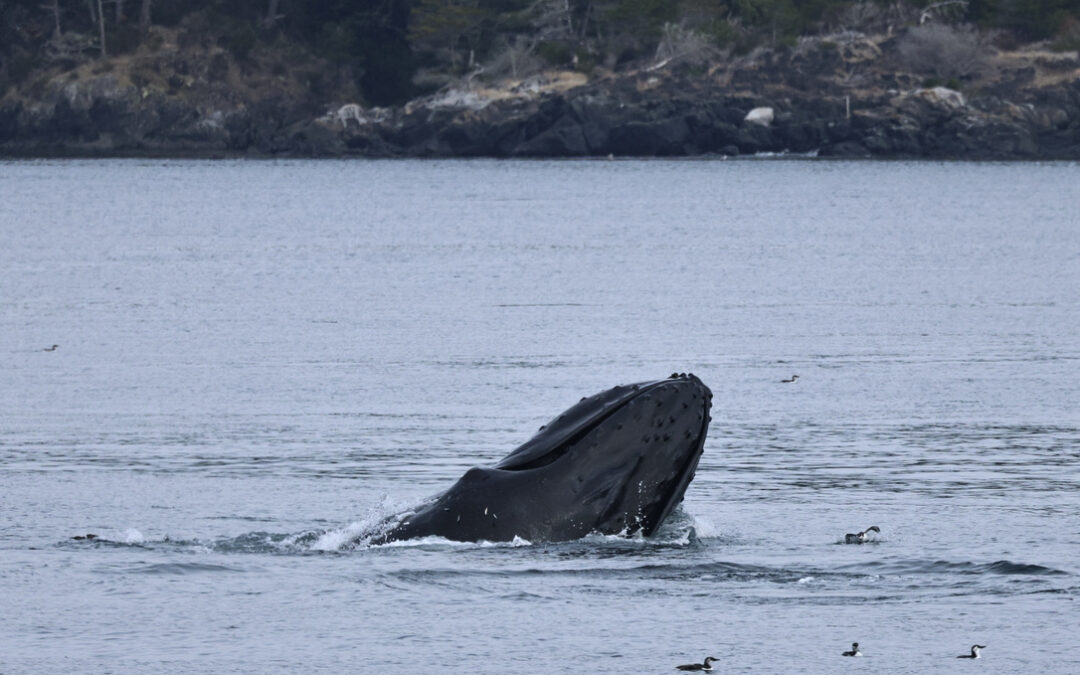
Autumn 2026: 3-Day Wildlife Cruise Trip Log
Day 1: Smith & Minor Islands, Deception Pass, orcas at Bird Rocks, sea lions at Whale Rocks (82 nm) We departed on Tuesday from Port Townsend under the cover of fog, but in great spirits. Instead of the high winds forecast for the day, we found flat, calm seas all...
Get Whale Updates
Get recent whale sightings, seasonal trip tips, and occasional seat alerts. Usually 1–3 useful emails per month; less often in winter. We respect your privacy; we will never share your email.